
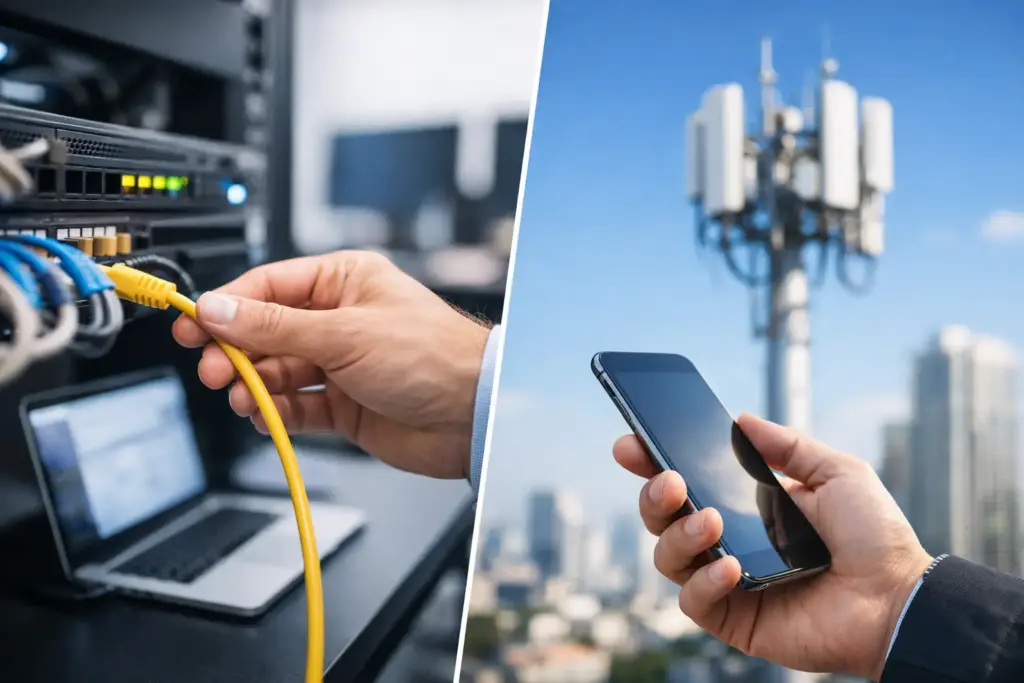
A Teams meeting that stutters as soon as colleagues open files simultaneously, a payment terminal that malfunctions, or a cloud application that is slow to respond: that is when the choice of connectivity suddenly becomes very concrete. Are you unsure about a business internet connection or 5G? Then it is not just about the highest possible speed. Availability, stability, security, and the way you work determine which solution truly helps your business move forward.
Start with the way your organization works
A fixed business internet connection and 5G can both be a good fit for an SME, but they do not solve the same problem. A fixed connection is typically intended as the reliable foundation for an office, shop, practice, or other fixed location. 5G, on the other hand, offers a great deal of flexibility: you can get online quickly, connect a temporary location, and have a useful backup if your primary connection is unavailable.
Therefore, first look at what travels over your network on a daily basis. Do employees primarily work in Microsoft 365, do they make calls via VoIP, and do they make video calling commonplace? Are there cameras, a guest network, point-of-sale systems, or devices that require a continuous connection? If so, your organization requires a different setup than a freelancer who regularly works on location and primarily uses a laptop and phone.
The number of concurrent users also counts. Downloading is not the only thing that requires capacity. For cloud storage, online meetings, telephony, and sending large files, upload speed is at least as relevant. In practice, this often only becomes apparent when the network is already under pressure.
When a fixed business internet connection makes sense
For a fixed business location, fiber optic is usually the first choice, provided it is available at your address. Fiber optics offers high, often symmetrical speeds. This means that uploading and downloading can be comparably fast. This provides peace of mind, especially for organizations that work extensively with cloud environments, VoIP, video calling, backups, or large files.
Moreover, a business connection distinguishes itself not only by capacity. The agreements regarding outage handling, availability, and support can align better with business continuity than a consumer connection. The precise guarantees vary by provider and subscription, so always check what has actually been agreed upon. A short response time is different from a guaranteed recovery time.
Stability for fixed workstations
A cable connection is generally less affected by fluctuating conditions than mobile internet. The quality of 5G depends on factors including coverage, distance to a cell tower, network congestion, and router placement. In an area with good coverage, 5G can be fast, but performance can vary from moment to moment.
For an office with multiple workstations, that predictability is valuable. Think of phone calls with clients, access to a central server, security cameras, and payment transactions. You don't want those processes to depend on mobile network congestion on a busy afternoon.
More room for growth and management
A fixed business connection is also easier to make part of a managed network environment. You can set up network segments for employees, guests, telephony, and smart devices. This helps maintain overview and security as your organization grows.
Furthermore, it is wise to look beyond the internet speed on paper. A well-functioning business network also requires professional Wi-Fi coverage, a suitable firewall, and monitoring. A fast line does not compensate for a Wi-Fi access point located in the wrong place or a network that is not tailored to the number of users.
When 5G is a strong business choice
5G is much more than internet on the go. For some situations, it is actually the fastest and most practical way to get a business location online. Especially when fiber optic is not yet available, a temporary connection is needed, or excavation is not an option.
A start-up in a multi-tenant building, for example, can get online quickly with a 5G router. 5G also offers a solution for events, construction sites, pop-up shops, and temporary project offices. You take the connection with you or relocate it without having to wait for a new physical connection.
The quality stands or falls with the location
5G does not guarantee the same performance at every address. Therefore, test the coverage at the location where the router will be placed, not just outside the building. Concrete, metal, double-glazed windows, and the orientation of the building can noticeably affect the mobile signal.
A good router and possibly an external antenna make a big difference. Place the equipment as high and as unobstructed as possible, preferably near a window on the side with the best range. After installation, also have your Wi-Fi network checked to ensure it is properly configured. A strong 5G signal is of little use if employees have poor wireless coverage indoors.
Additionally, take data usage and terms into account. For a small workplace with normal office use, 5G may be more than sufficient. For continuous camera feeds, large daily backups, or many simultaneous video meetings, a wired connection is often more predictable and a better fit in the long run.
Business internet connection or 5G: often it is both
The most reliable choice is often not a choice between two technologies, but a combination of them. A fixed connection then acts as the primary line. 5G is deployed as a backup that automatically takes over when the main connection fails.
This is relevant for companies where connectivity costs money directly. Think of a retail store with card payments, a healthcare practice with online patient records, an office with cloud telephony, or an organization that operates remotely. In the event of an outage, a 5G backup can ensure that essential processes continue while the fixed connection is restored.
Not every organization needs such a facility. For a sole proprietorship, a mobile hotspot may suffice as an emergency solution. However, as soon as multiple employees, telephony, or customer-critical systems depend on the internet, automatic switching is a wise investment in continuity.
Don't just compare the monthly price
A low subscription price seems attractive, but it says little about the actual value for your business. Therefore, compare solutions on these five points:
- Availability: how important is the internet for your daily services and what happens in the event of an outage?
- Capacity: how many employees and devices use cloud software, telephony, Wi-Fi, and video simultaneously?
- Location: is fiber optic available and how good is the 5G coverage inside the building?
- Support: who helps you with malfunctions, settings, and expanding your network?
- Future plans: do you expect more workspaces, additional locations, cameras, or more intensive cloud usage?
For a fixed connection, ask about the upload and download speeds, any service agreements, and the options for a static IP address if required for specific applications. For 5G, ask about the router, data limits, coverage, and the possibility of using an external antenna.
Make the connection part of your overall ICT environment
The internet is the foundation of your digital workplace, but it never operates in isolation from the rest. Even the best connection yields little benefit if your telephony is not properly configured, devices are outdated, or employees connect to an unsecured guest network.
Therefore, map out in advance which services depend on the internet. Consider email, cloud storage, VoIP, website management, payment terminals, camera security, and remote access. Also determine what must continue to function in the event of an outage. This allows you to specifically determine whether a simple 5G solution is suitable, a fixed connection is necessary, or if a combination provides the necessary reliability.
Next, do not let the installation stop at connecting the router. Check Wi-Fi coverage, security, cabling, and telephony operation. With a managed setup, you maintain better visibility into performance and can resolve issues before they disrupt your workday.
Cloudformatie helps organizations with this by viewing connectivity in conjunction with network management, Wi-Fi, workspaces, and communication. This results not in a standalone internet solution, but in an environment that fits how your employees and customers want to work.
Ultimately, do not choose the technology that seems fastest on paper, but the connection that keeps your company reachable even on a busy workday. A brief assessment of your location, usage, and risks often provides more clarity than simply comparing two speeds side by side.